geo.wikisort.org - Island
Borda Rock (Bulgarian: скала Борда, romanized: skala Borda, IPA: [skɐˈla borˈda]) is the rock off the NW coast of Smith Island in the South Shetland Islands, Antarctica 270 m long in southwest-northeast direction and 90 m wide (extending 543 by 175 m together with the adjacent minor rocks). Its surface area is 1.46 ha. The vicinity was visited by early 19th century sealers.[1]
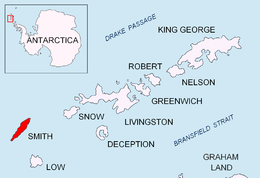 Location of Smith Island in the South Shetland Islands | |
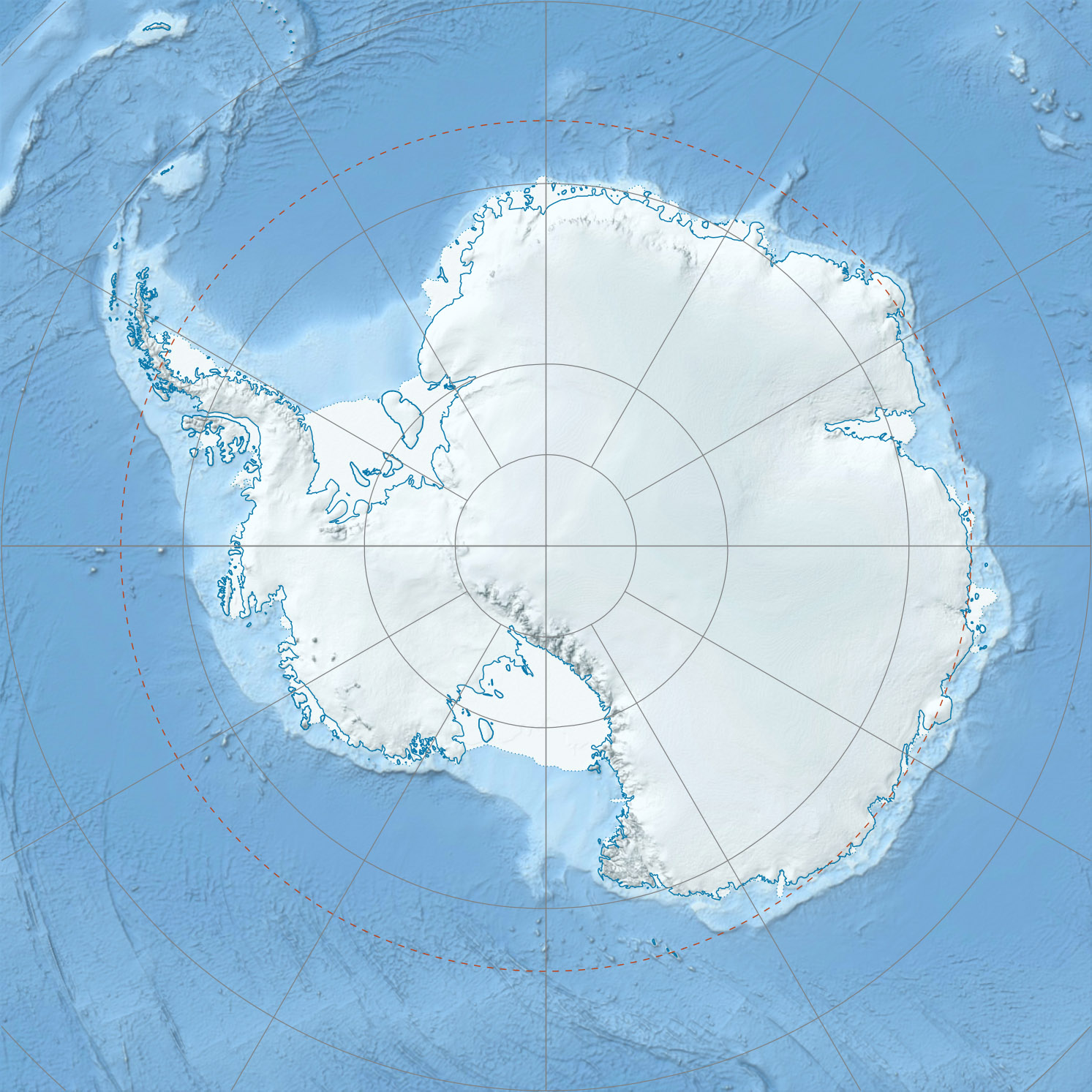  Borda Rock Location of Borda Rock 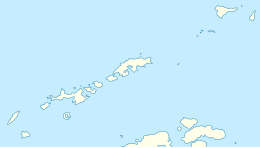 Borda Rock Borda Rock (South Shetland Islands) | |
| Geography | |
|---|---|
| Location | Antarctica |
| Coordinates | 62°55′01.6″S 62°32′15″W |
| Archipelago | South Shetland Islands |
| Area | 1.46 ha (3.6 acres) |
| Length | 270 m (890 ft) |
| Width | 90 m (300 ft) |
| Administration | |
| Administered under the Antarctic Treaty | |
| Demographics | |
| Population | uninhabited |

The feature is named after Jean-Charles de Borda (1733-1799), a French mathematician, physicist and Navy officer who refined the reflecting circle; in association with other names in the area deriving from the early development or use of geodetic instruments and methods.
Location
Borda Rock is located at 62°55′01.6″S 62°32′15″W,[2] which is 240 m northwest of Gregory Point. Bulgarian mapping in 2009 and 2017.
See also
Maps
- L. Ivanov. Antarctica: Livingston Island and Greenwich, Robert, Snow and Smith Islands. Scale 1:120000 topographic map. Troyan: Manfred Wörner Foundation, 2010. ISBN 978-954-92032-9-5 (First edition 2009. ISBN 978-954-92032-6-4)
- South Shetland Islands: Smith and Low Islands. Scale 1:150000 topographic map No. 13677. British Antarctic Survey, 2009
- L. Ivanov. Antarctica: Livingston Island and Smith Island. Scale 1:100000 topographic map. Manfred Wörner Foundation, 2017. ISBN 978-619-90008-3-0
- Antarctic Digital Database (ADD). Scale 1:250000 topographic map of Antarctica. Scientific Committee on Antarctic Research (SCAR). Since 1993, regularly upgraded and updated
Notes
- L. Ivanov. General Geography and History of Livingston Island. In: Bulgarian Antarctic Research: A Synthesis. Eds. C. Pimpirev and N. Chipev. Sofia: St. Kliment Ohridski University Press, 2015. pp. 17–28
- Bulgarian Antarctic Gazetteer. Antarctic Place-names Commission
References
- Bulgarian Antarctic Gazetteer. Antarctic Place-names Commission. (details in Bulgarian, basic data in English)
External links
- Borda Rock. Adjusted Copernix satellite image
This article includes information from the Antarctic Place-names Commission of Bulgaria which is used with permission.


 | This Smith Island (South Shetland Islands) location article is a stub. You can help Wikipedia by expanding it. |
На других языках
[de] Borda Rock
Der Borda Rock (englisch; bulgarisch скала Борда .mw-parser-output .Latn{font-family:"Akzidenz Grotesk","Arial","Avant Garde Gothic","Calibri","Futura","Geneva","Gill Sans","Helvetica","Lucida Grande","Lucida Sans Unicode","Lucida Grande","Stone Sans","Tahoma","Trebuchet","Univers","Verdana"}skala Borda) ist ein in südwest-nordöstlicher Ausrichtung 270 m langer und 90 m breiter Klippenfelsen vor der Nordwestküste von Smith Island im Archipel der Südlichen Shetlandinseln. Er liegt 240 m nordwestlich des Gregory Point.- [en] Borda Rock
Другой контент может иметь иную лицензию. Перед использованием материалов сайта WikiSort.org внимательно изучите правила лицензирования конкретных элементов наполнения сайта.
WikiSort.org - проект по пересортировке и дополнению контента Википедии