geo.wikisort.org - Mountains
Serbia is mountainous, with complex geology and parts of several mountain ranges: Dinaric Alps in the southwest, the northwestern corner of the Rila-Rhodope Mountains in the southeast of the country, Carpathian Mountains in the northeast, and Balkan Mountains and the easternmost section of Srednogorie mountain chain system in the east, separated by a group of dome mountains along the Morava river valley. The northern province of Vojvodina lies in the Pannonian plain, with several Pannonian island mountains. Mountains of Kosovo[lower-alpha 1] are listed in a separate article.
List
This is the list of mountains and their highest peaks in Serbia, excluding Kosovo.[lower-alpha 1] When a mountain has several major peaks, they are listed separately.[1][2]


Peaks over 2,000 meters
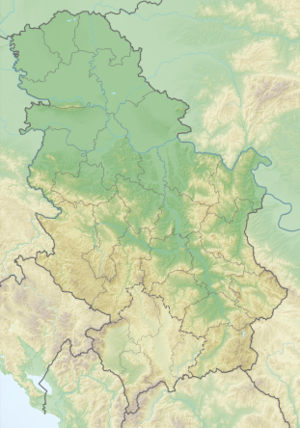

The following lists only those mountain peaks which reach over 2,000 meters in height.[32]
| Peak | Mountain | Height (m) |
|---|---|---|
| Midžor | Stara planina | 2,169 |
| Pogled | Mokra Gora[lower-alpha 1] | 2,156 |
| Dupljak | Stara planina | 2,032 |
| Pančićev vrh | Kopaonik | 2,017 |
Notes
- The political status of Kosovo is disputed. Having unilaterally declared independence from Serbia in 2008, Kosovo is formally recognised as an independent state by 97 UN member states, while Serbia continues to claim it as part of its own sovereign territory.
References
- Jovan Đokić. "Katalog planina Srbije". PSD Kopaonik Beograd. Archived from the original on 2011-05-18.
- http://solair.eunet.rs/~s.ilic/planine.txt (Adopted with author's permission.)
- "Niške planine". Retrieved 2010-08-23.
- "Data on Vranje". Official website of Vranje. Retrieved 2010-10-11.
- "Bešnjaja - Lisin laz 613 m". planine.net.
- Mountains in Serbia Archived 2010-06-06 at the Wayback Machine
- "Geografija Kosjerića". Retrieved 2010-10-15.[permanent dead link]
- "Planine". Municipality of Ivanjica. Retrieved 2010-08-16.
- "Vlasina – Besna Kobila – Dukat – Bosilegrad" (in Serbian). Staze i Bogaze. Archived from the original on 2010-09-25. Retrieved 2010-10-11.
- "Nature:Mountains". Tourist Organization of Sjenica. Archived from the original on 2010-03-22. Retrieved 2010-08-16.
- "Planine opštine Kraljevo" (in Serbian). Kraljevo.com. Retrieved 2010-10-11.
- "Kanjon Jerme – I dan, Greben planina". PEK "Gora" Kragujevac. Retrieved 2010-10-11.
- "Vranj (884 m) geokeš" (in Serbian). Staze i Bogaze. Retrieved 2010-08-17.
- "Valj.planine- Jablanik 1274 m (od doma Krušik)". Staze i bogaze. Retrieved 2010-10-18.
- "Prirodne lepote". Municipality of Gornji Milanovac. Archived from the original on 2011-10-06. Retrieved 2010-10-21.
- "Ježevac (675m)" (in Serbian). Staze i bogaze. Archived from the original on 2010-09-30. Retrieved 2010-10-21.
- "Geografske odlike Dragačeva". Retrieved 2010-08-16.
- Planina Kukavica, Tourist Portal Vladičin Han, archived from the original on 2011-07-17, retrieved 2010-08-26
- Lazareva pećina (Zlot) – Veliki Malinik – Mali Malinik – Valja Rnž (Podgorac) (17,5km) (in Serbian), Staze i bogaze
- Geografski položaj, Gljivarsko društvo Valjevo, retrieved 2010-08-26
- "Medvednik". Valjevski turistički info centar. Archived from the original on 2011-07-22.
- "Ozren 2" (in Serbian). Tourist centre of Sokobanja. Retrieved 2010-08-16.
- "Varda i Pobijenik" (in Serbian). PD Pobeda Belgrade.
- "Planina Ruj" (in Serbian). Retrieved 2010-10-21.
- "SUBJEL – DIVČIBARE – 04.06.2006". PD Pobeda. Retrieved 2010-10-15.
- Galerija slika sa Suve planine – satelitski snimci. (in Serbian), Suva Planina.com, retrieved 2010-08-26
- "Svrljiške planine" (in Serbian). PD Pobeda. Retrieved 2010-10-11.
- Geologija i geomorfologija (in Serbian), National park Tara
- "Tupižnica: Bučje – Gornja Bela Reka (20 km)". Staze i bogaze. Retrieved 2010-08-23.
- "Seli se glavno oko Srbije" (in Serbian). Večernje Novosti. 2010-06-12.
- "Eko klub Željin" (in Serbian). Retrieved 2010-10-11.
- Statistical Yearbook of Serbia 2007; chapter 1. titled Geographical Review, Table 1.6. titled Mountain Peaks over 2000 m at page 19. Publicized by the Statistical Office of the Republic of Serbia, primary source of information is Military Geographical Institute, Belgrade (Army of Serbia)
See also

- Geography of Serbia
- List of rivers in Serbia
- List of lakes in Serbia
- List of hills in Belgrade
- Dinaric Alps
External links
Serbia articles | |||||||||||
|---|---|---|---|---|---|---|---|---|---|---|---|
| History |
|  | |||||||||
| Geography | |||||||||||
| Politics |
| ||||||||||
| Economy |
| ||||||||||
| Society |
| ||||||||||
| |||||||||||


На других языках
- [en] List of mountains in Serbia
[fr] Liste des montagnes de Serbie
Liste complète des montagnes de Serbie.[it] Montagne della Serbia
Il territorio della Serbia è caratterizzato da una forte alternanza di situazioni ambientali. A nord si estende la propaggine meridionale della Pianura Pannonica in cui si trovano i bassi rilievi della Fruška Gora (in serbo: Фрушка гора?) che raggiungono al massimo i 500 m s.l.m. di altitudine.Другой контент может иметь иную лицензию. Перед использованием материалов сайта WikiSort.org внимательно изучите правила лицензирования конкретных элементов наполнения сайта.
WikiSort.org - проект по пересортировке и дополнению контента Википедии