geo.wikisort.org - River
The Han River (simplified Chinese: 韩江; traditional Chinese: 韓江; pinyin: Hán Jiāng) is a river in southeast China. It is located mainly in eastern Guangdong province and has a total length of 410 kilometres (250 mi). The river is combined with two main tributary rivers, Mei River and Ting River, at Sanheba (三河坝), Dabu County.[2] Han River flows south through the Han River Delta entering the South China Sea at Chenghai District and Longhu District of Shantou.[1] The Teochew people refer to the river as "the Mother River".[3]
| Han River Hán Jiāng | |
|---|---|
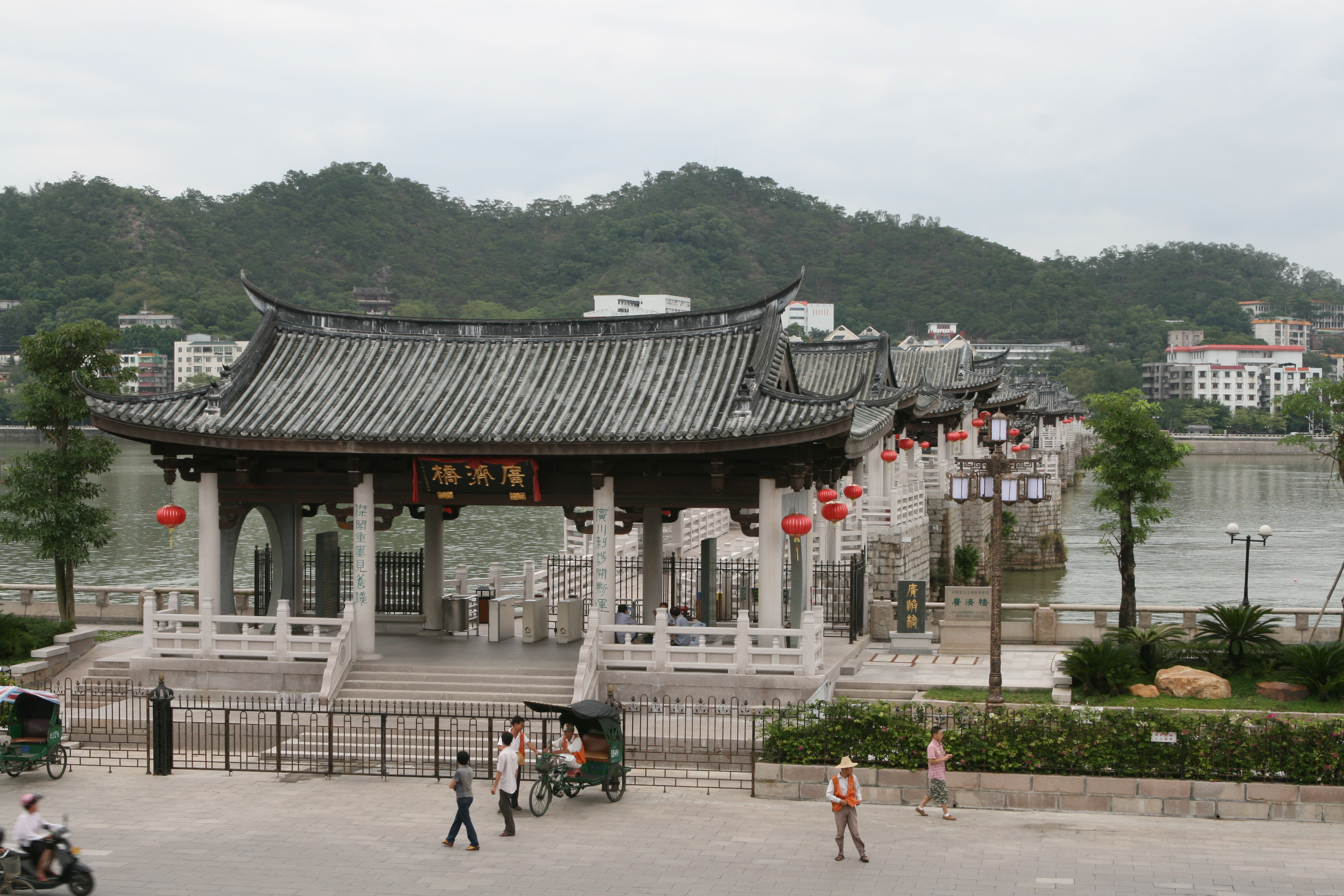
 Looking across the Han River from Chaozhou City. | |
| Native name | 韩江 |
| Location | |
| Country | China |
| Province | Guangdong, Fujian, Jiangxi |
| Cities | Meizhou, Chaozhou, Shantou |
| Physical characteristics | |
| Source | Mount Qixingdong (Mei River) |
| • location | Zijin County, Guangdong |
| Mouth | South China Sea |
• location | Shantou, Guangdong |
| Length | 410 km (250 mi)[1] |
| Basin size | 30,112 km2 (11,626 sq mi)[1] |
| Discharge | |
| • average | 870 m3/s (31,000 cu ft/s)[1] |
| • minimum | 33 m3/s (1,200 cu ft/s)[1] |
| • maximum | 13,300 m3/s (470,000 cu ft/s)[1] |
| Basin features | |
| Tributaries | |
| • left | Wuhua River, Ning River, Shiku River |
| • right | Ting River, Meitan River |
The river is named after Han Yu, a writer, poet and government official of the Tang dynasty, in honor of his contribution to Chaoshan.[4] It was originally named as E Xi (simplified Chinese: 恶溪; traditional Chinese: 惡溪; lit. 'ferocious river') before Han Yu's exile to Chaozhou. The river became pacific under Han's river regulation and named after him after his departure.[5]
Gallery



References
| Authority control |
|
|---|

 | This Guangdong location article is a stub. You can help Wikipedia by expanding it. |
 | This article related to a river in China is a stub. You can help Wikipedia by expanding it. |
На других языках
[de] Han Jiang (Guangdong)
Der Han Jiang (chinesisch .mw-parser-output .Hant{font-size:110%}韓江 / .mw-parser-output .Hans{font-size:110%}韩江, Pinyin Hán Jiāng, Jyutping Hon4 Gong1 – „Han-Strom, Han-Fluss“) ist ein Fluss im Osten der südchinesischen Provinz Guangdong.- [en] Han River (Guangdong)
[it] Fiume Han (Guangdong)
Il fiume Han (cinese tradizionale: 韓江; cinese semplificato: 韩江; pinyin: Hán Jiāng) è un fiume della Cina meridionale che sfocia nel mar Cinese meridionale. Attraversa principalmente la provincia orientale del Guangdong e ha una lunghezza totale di 410 km, che ne fa il secondo fiume più lungo della provincia. Prende nome dal poeta Han Yu (768-824 d.C.).[ru] Ханьцзян (река, впадает в Южно-Китайское море)
Ханьцзян (кит. упр. 韩江, пиньинь Hán Jiāng) — река в южном Китае, в восточной части провинции Гуандун.[1]Другой контент может иметь иную лицензию. Перед использованием материалов сайта WikiSort.org внимательно изучите правила лицензирования конкретных элементов наполнения сайта.
WikiSort.org - проект по пересортировке и дополнению контента Википедии