geo.wikisort.org - River
The Puelo River has its origin in Lake Puelo in Argentine, and flows north-west through the Andes into Chile and the Reloncaví Estuary of the Reloncaví Sound at the northern end of the Gulf of Ancud.[2]
| Puelo River | |
|---|---|
 Bridge on the Carretera Austral | |
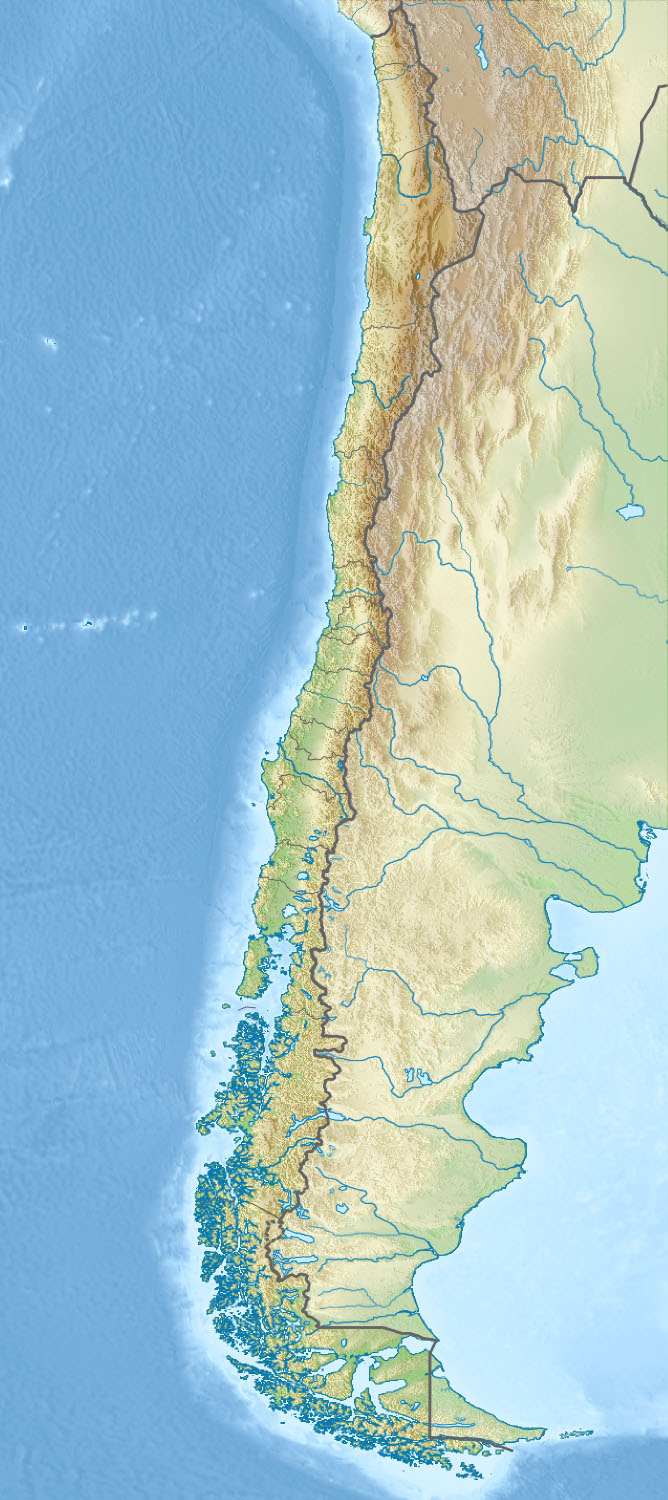  Location of mouth | |
| Native name | Río Puelo (Spanish) |
| Location | |
| Countries |
|
| Physical characteristics | |
| Source | |
| • location | Puelo Lake |
| Mouth | |
• location | Reloncaví Estuary (Pacific Ocean) |
• coordinates | 42.116667°S 71.716667°W |
| Discharge | |
| • average | 670 m3/s (24,000 cu ft/s)[1] |
Course
Just 800 metres (2,600 ft) downstream from its source in Puelo Lake, the river enters Inferior Lake.[3] After leaving the lake, the river flows in a generally northwesterly direction, receiving the waters of a chain of lakes, the largest being Azul and Las Rocas. It also receives the waters of Ventisquero and Traidor rivers. A part of the northernmost border of Pumalín Park approximately parallels the course of the Ventisquero River. Traidor River rises in Hornopirén National Park.
A large northern tributary of the Puelo, the Manso, has its sources in Mascardi Lake and other lakes and streams south-east of the Cerro Tronador, also in Argentina, and flows south-west through the Andes to unite with the Puelo a few kilometers west of the 72nd meridian.[4] Puelo river's lower course is impeded in such a manner as to form three small lakes, called Superior, Inferior and the Tagua Tagua Lake.[4]
References
- "Hidrografía Región de los Lagos". Biblioteca del Congreso Nacional de Chile (in Spanish). Retrieved 2022-03-02.
- "Rio Puelo". GeoNames. Retrieved July 24, 2021.
- Chebez, J.C. (2005). Patagonia Norte. Guía de las Reservas Naturales de la Argentina.
- Chisholm, Hugh, ed. (1911). . Encyclopædia Britannica. Vol. 6 (11th ed.). Cambridge University Press. p. 144.
 | This article about a place in Chubut Province, Argentina is a stub. You can help Wikipedia by expanding it. |
 | This article related to a river in Argentina is a stub. You can help Wikipedia by expanding it. |
 | This Los Lagos Region location article is a stub. You can help Wikipedia by expanding it. |
На других языках
- [en] Puelo River
[es] Río Puelo
El río Puelo es un curso fluvial binacional que nace en Argentina, cruza a Chile y desemboca en las costas del océano Pacífico.Другой контент может иметь иную лицензию. Перед использованием материалов сайта WikiSort.org внимательно изучите правила лицензирования конкретных элементов наполнения сайта.
WikiSort.org - проект по пересортировке и дополнению контента Википедии