geo.wikisort.org - Reservoir
Cordell Hull Lake is a lake in the Cumberland River in north-central Tennessee, about forty miles east of Nashville, in the vicinity of Carthage. It covers approximately 12,000 acres (49 km2).
| Cordell Hull Lake | |
|---|---|
 Cordell Hull Lake | |
  Cordell Hull Lake 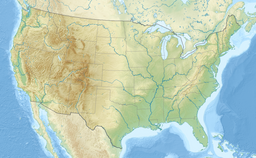 Cordell Hull Lake | |
| Location | Smith / Jackson / Clay counties, Tennessee, US |
| Coordinates | 36°17′24″N 085°56′38″W |
| Type | Reservoir |
| Primary inflows | Cumberland River |
| Primary outflows | Cumberland River |
| Catchment area | 8,096 sq mi (20,970 km2)[1] |
| Basin countries | United States |
| Managing agency | United States Army Corps of Engineers |
| Built | 1963—1973[2] |
| Max. length | 72 mi (116 km)[3] |
| Surface area | 11,960 acres (48.4 km2)[3] |
| Average depth | 20 ft (6.1 m)[3] |
| Max. depth | 90 ft (27 m)[3] |
| Water volume | 310,900 acre⋅ft (0.3835 km3)[1] |
| Shore length1 | 381 mi (613 km)[3] |
| Surface elevation | 504 ft (154 m)[3] |
| 1 Shore length is not a well-defined measure. | |
Cordell Hull Dam, on the Cumberland River, was built by the United States Army Corps of Engineers between May 1963 and November 1973 for navigation, hydroelectric power generation and recreation.[4] The dam is a concrete and earthen gravity structure, 87 feet high (above streambed), with a generator capacity of 100 megawatts.[5] It impounds 259,100 acre-feet (0.3196 km3) at normal maximum pool, with a maximum flood storage of 310,900 acre-feet (0.3835 km3).
Both are named for Cordell Hull, former United States Secretary of State.[2]
References
- "National Inventory of Dams". U.S. Army Corps of Engineers. Retrieved Sep 6, 2011.
- "Lake History". Cordell Hull Lake. U.S. Army Corps of Engineers. Archived from the original on 2012-05-16. Retrieved Sep 6, 2011.
- "Frequently Asked Questions". Cordell Hull Lake. U.S. Army Corps of Engineers. Archived from the original on May 3, 2012. Retrieved Sep 6, 2011.
- "Lake History". Archived from the original on 2012-05-16. Retrieved 2011-09-06.
- "Statistical Information". Archived from the original on 2012-05-10. Retrieved 2012-07-30.
External links
- U.S. Army Corps of Engineers web site
- U.S. Geological Survey Geographic Names Information System: Cordell Hull Lake
- Cordell Hull Birthplace and Museum State Park
Lakes and reservoirs of Tennessee | |
|---|---|
| East Tennessee |
|
| Middle Tennessee | |
| West Tennessee | |
 Lakes portal Lakes portal | |
Authority control | |
|---|---|
| General |
|
| National libraries | |

 | This Clay County, Tennessee geography–related article is a stub. You can help Wikipedia by expanding it. |
 | This Jackson County, Tennessee geography–related article is a stub. You can help Wikipedia by expanding it. |
 | This Smith County, Tennessee geography–related article is a stub. You can help Wikipedia by expanding it. |
Другой контент может иметь иную лицензию. Перед использованием материалов сайта WikiSort.org внимательно изучите правила лицензирования конкретных элементов наполнения сайта.
WikiSort.org - проект по пересортировке и дополнению контента Википедии