geo.wikisort.org - River
The Uele (Russian: Уэле; Yakut: Үөлэ) is a river in Yakutia (Sakha Republic), Russia. It has a length of 313 kilometres (194 mi) and its drainage basin area is 19,200 square kilometres (7,400 sq mi).[1] The river basin is a desolate area devoid of human settlements.[2]
| Uele Уэле / Үөлэ | |
|---|---|
 Anabar basin with the Uele in the upper right | |
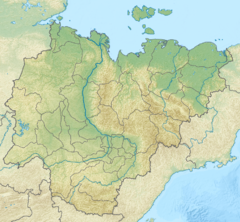  Mouth location in Yakutia, Russia  Uele (Yakutia) (Russia) | |
| Location | |
| Country | Russia |
| Physical characteristics | |
| Source | |
| • location | Near lake Sobaka-Lakh |
| • coordinates | 72°18′04″N 117°53′16″E |
| Mouth | Anabar Bay Laptev Sea |
• coordinates | 73°20′36″N 113°48′46″E |
• elevation | 0 m (0 ft) |
| Length | 313 km (194 mi) |
| Basin size | 19,200 km2 (7,400 sq mi) |
| Discharge | |
| • average | 96 m3/s (3,400 cu ft/s) |
Course
The Uele has its sources near lake Sobaka-Lakh in the North Siberian Lowland. The river flows roughly northwestwards in a winding channel across a floodplain with numerous lakes. Finally it enters the eastern side of the inner Anabar Bay just east of the mouth of the Anabar.[3][4]
Tributaries
Its main tributaries are the Kraynyaya, Bayan, Darkylakh, Onkuchakh-Yuryakh and Salga from the right, as well as the Khatygyn-Uelete, Byorolyokh-Ayan and Sasyr-Tyobyulekh from the left.[2]
Fauna
The Uele is frozen most of the year. It stays under ice between the end of September/beginning of October and the end of May/beginning of June. The river is an important habitat for nelma, as recorded in the Red Data Book of the Russian Federation.[5]
See also
References
- "Река Юёлэ in the State Water Register of Russia". textual.ru (in Russian).
- Water of Russia - Уэле
- Google Earth
- "Топографска карта S-49-XXIX,XXX; M 1:1 000 000 - Topographic USSR Chart (in Russian)". Retrieved 8 February 2022.
- Nelma (Uelenskaya population). Stenodus leucichthys - Red Book of the Republic of Sakha (Yakutia) . Protected Areas of Russia
External links

На других языках
- [en] Uele (Yakutia)
[it] Uėle
L'Uėle (anche Uele) è un fiume della Russia siberiana settentrionale (Repubblica Autonoma della Jacuzia), tributario del mare di Laptev.[ru] Уэле (река, впадает в море Лаптевых)
Уэле[2] (устар. Юёлэ[3], у Х. Лаптева — Олем[4]) — река в России, протекает по территории Анабарского улуса Якутии. Длина реки 313 километров, площадь водосборного бассейна равна 19200 км²[3].Другой контент может иметь иную лицензию. Перед использованием материалов сайта WikiSort.org внимательно изучите правила лицензирования конкретных элементов наполнения сайта.
WikiSort.org - проект по пересортировке и дополнению контента Википедии