geo.wikisort.org - Bacino
Paasselkä (chiamato anche Paasivesi) è un lago di forma ovale con il cratere eroso nel Savo meridionale, in Finlandia. Il lago, che è una parte del lago Orivesi, che a sua volta è parte del lago Saimaa, è privo di isole, il che lo rende diverso da altri laghi della regione. Paasselkä è anche insolitamente profondo, 75 metri al punto più profondo.
| Paasselkä | |
|---|---|
| Stato |  Finlandia Finlandia |
| Provincia | Finlandia orientale |
| Regione | Savo meridionale |
| Distretto | Kerimäki |
| Coordinate | 62°09′06.17″N 29°24′57.22″E |
| Altitudine | 75,9 m s.l.m. |
| Dimensioni | |
| Lunghezza | 13 km |
| Larghezza | 9 km |
| Profondità massima | 75 m |
| Sviluppo costiero | 10 km |
| Idrografia | |
| Origine | Cratere meteoritico |
| Isole | nessuna |
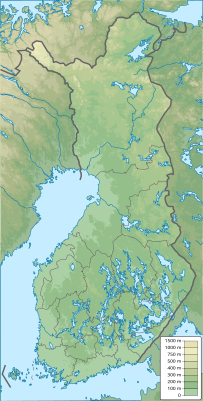  Paasselkä | |
L'impatto che ha formato Paasselkä è avvenuto circa 229 milioni di anni fa, durante il Triassico, e ha colpite le rocce cristalline e alcune arenarie sovrastanti lo Scudo baltico. A causa della forma insolita e di alcune anomalie dei campi magnetici, Paasselkä era sospettato di avere un'origine meteorica da lungo tempo, ciò è stato confermato dopo una profonda foratura, nel 1999, rendendo Paasselkä il nono cratere d'impatto noto in Finlandia. A differenza di molti crateri finlandese, non sembra essere stata sepolta sotto strati di sedimenti[1]
Fenomeni luminosi
I Päässelän pirut, o diavoli di Paasselkä, sono un affermato fenomeno che si verifica talvolta nel lago o nella palude o nella foresta nelle immediate vicinanze. La luce è stata descritta come una palla che si muove a velocità diverse, o è completamente ferma, talvolta poi le sfere sono numerose. Il fenomeno è noto da molto tempo, in forma scritta se ne ha notizia dal XVIII secolo ma oralmente fa dai tempi ancestrali parte dei racconti popolari locali, che hanno dato il nome al fenomeno di "diavoli"; la gente del posto pensa che le sfere lucenti siano state create da esseri malvagi. Le anomalie magnetiche in connessione con il cratere d'impatto potrebbe essere correlato al fenomeno.
Note
- Template:Cite Earth Impact DB
Bibliografia
- Pesonen, L. J.; Kuivasaari, T.; Lehtinen, M.; Elo, S., Paasselkä: A New Meteorite Impact Structure in Eastern Finland, in Meteoritics & Planetary Science, vol. 34, 1999, pp. A90 – A91, Bibcode:1999M&PSA..34R..90P.
- Schmieder, M.; Moilanen, J.; Buchner, E., Impact melt rocks from the Paasselkä impact structure (SE Finland): Petrography and geochemistry, in Meteoritics & Planetary Science, vol. 43, n. 7, 2008, pp. 1189–1200, Bibcode:2008M&PS...43.1189S, DOI:10.1111/j.1945-5100.2008.tb01122.x.
Voci correlate
- Lago di Lappajärvi
Collegamenti esterni
- (EN) Database degli impatti terrestri, su unb.ca.
- (EN) Struttura dell'impatto Paasselkä, su somerikko.net. URL consultato il 12 febbraio 2006 (archiviato dall'url originale il 27 settembre 2007).


На других языках
[de] Paasselkä
Paasselkä (früher Paasivesi) ist ein ovalförmiger See, der in einem erodierten Impaktkrater in Südsavo in Finnland liegt. Der See bildet einen Teilsee des Orivesi, welcher wiederum Teil des Saimaa-Seensystems ist. Der Paasselkä zeichnet sich, im Gegensatz zu den anderen Seen in der Region, durch ein Fehlen von Inseln aus. Er ist ungewöhnlich tief und erreicht eine maximale Wassertiefe von 75 m.[en] Paasselkä
Paasselkä (earlier Paasivesi, both names roughly mean 'Stone lake') is an oval-shaped lake formed in an eroded impact crater in Southern Savonia, Finland. The lake, which is a part of Orivesi, which is in turn part of the Greater Saimaa, is devoid of islands which makes it different from other lakes in the region. Paasselkä is also unusually deep, 75 m at the deepest point.- [it] Paasselkä
Другой контент может иметь иную лицензию. Перед использованием материалов сайта WikiSort.org внимательно изучите правила лицензирования конкретных элементов наполнения сайта.
WikiSort.org - проект по пересортировке и дополнению контента Википедии