geo.wikisort.org - Reservoir
Capoey is a village in the Pomeroon-Supenaam Region of Guyana. The village is mainly inhabited by Lokono Amerindians.[4] It is located on Lake Capoey, a blackwater lake, which is one of largest lakes of Essequibo.[4]
Capoey | |
|---|---|
Village | |
 | |
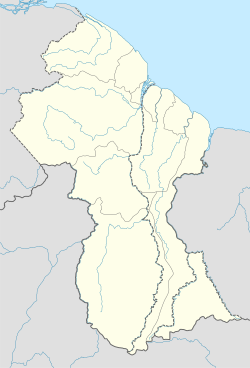  Capoey Location in Guyana | |
| Coordinates: 7.1932°N 58.5340°W | |
| Country |  Guyana Guyana |
| Region | Pomeroon-Supenaam |
| Government | |
| • Toshao | Ralph Hendricks[1] |
| Area | |
| • Total | 9.31 km2 (3.59 sq mi) |
| Population (2012)[3] | |
| • Total | 523 |
| • Density | 56/km2 (150/sq mi) |
History
Capoey was originally settled by Wapishana who named the village. The name translates to "Land of the Rising Moon". The tribe was wiped out by a plague. A group of Lokono Amerindians who were enslaved on a plantation on the Essequibo coast escaped from captivity, crossed the lake, and resettled the abandoned village.[1] In the early 20th century, a mission was founded by the Methodist Church.
Overview
The economy of Capoey is based logging, subsistence farming, gold mining, and tourism has become important.[5] The village has a primary school, village office, and a health care clinic.[4] The village provides free transportation to the coast for secondary and trade education. Electricity is provided by solar panels.[4]
Lake Capoey

Lake Capoey is one of the largest lakes in Essequibo. The lake is known for its large beige beaches, black water,[4] and benabs (palm thatched hut).[1] The lake is steadily growing in size.[4]
Transport
The lake is accessible via a side road of the Essequibo Coast Road. The village is located on the other side of the lake, and can only be accessed by boat. There is a tiny hamlet on the northern edge of the lake called Mary Point which is part of the Capoey reserve.[4]
References
- Jemima Holmes (15 November 2021). "Lake Capoey: Land of the Rising Moon". iNews Guyana. Retrieved 3 December 2021.
- "2012 Population by Village". Statistics Guyana. Retrieved 3 December 2021.
- Joanna Dhanraj (25 November 2018). "Capoey". Stabroek News. Retrieved 3 December 2021.
- Jemima Holmes (28 November 2021). "Capoey hoping to produce star athletes, but needs resources". iNews Guyana. Retrieved 3 December 2021.

 Settlements in Guyana Settlements in Guyana | |
|---|---|
For the definition of city, town, etc see Settlements in Guyana. | |
| Cities |
|
| Towns |
|
| Villages |
|
| Communities |
|
| Estates |
|
| Missions |
|
Другой контент может иметь иную лицензию. Перед использованием материалов сайта WikiSort.org внимательно изучите правила лицензирования конкретных элементов наполнения сайта.
WikiSort.org - проект по пересортировке и дополнению контента Википедии